Wednesday, 26 September 2012

Hema Upadhyay


Hema Upadhyay
"I like to tell any stories, whether real or imaginative. These are even reflections of one's phobias, shortcomings. The recurring theme in my work is autobiographical. In addition, it is the cathartic factor that becomes the reason to take these objects and convert their ability. Yes…my work is cathartic in process."

Hema Upadhyay was born in Baroda in 1972, and completed her Bachelor's and Master's Degrees in painting and printmaking respectively from the Fine Arts Faculty of the M S University there. In the short time that Hema has had to develop her career (she graduated with her MFA in 1997), she has already taken giant steps and established herself very firmly among the new generation of Indian contemporary artists.

Upadhyay was the recipient of a National Scholarship from the Ministry of Human Resources, and also has to her credit annual awards from the Gujarat Lalit Kala Academy and the national Lalit Kala Academy for her work in the 10th International Triennale - India hosted in New Delhi.

Her talent was immediately recognized and Hema has been invited to showcase in her work in many group shows, even whilst she was in college, the most prestigious being the 4th and 5th annual 'Harmony' shows, 'Ideas and Images 2' at the NGMA, Mumbai and 'Mumbai Metaphor' hosted by the Tao Art Gallery.

Now settled and working in Mumbai, this Baroda artist and her painter husband, Chintan Upadhyay, have collaborated and worked together for many exhibitions. Most recently the duo worked jointly to create billboard and poster art for a show called 'Parthenogenesis' at the Ivan Dougherty Gallery on the campus of the Australian University of New South Wales. Labeled as 'kitsch' by some viewers and critics, the work Hema and Chintan produced is definitely a tongue-in-cheek statement, not necessarily against, but about the mass production and popular imagery that has taken over almost every aspect of urban life. Hema explains, saying, "Besides using pop imagery, our posters take a dig at our hybrid 'global' lifestyle."

Earlier, in 2001, Hema for the first time exhibited her work abroad, also in Australia. For an installation titled 'The Nymph and the Adult', she sculpted nearly 2000 lifelike cockroaches, infesting the gallery with them, to draw repulsion as well as fascination from her viewers. There was a purpose, however, to this display. At a very politically and militarily tense time in the South Asian Subcontinent, it raised the question on everyone's mind. Would cockroaches be the only survivors?

In the same year, Upadhyay held her first solo exhibition at the Chemould Art Gallery in Mumbai. Titled 'Sweet - Sweat Memories', the large mixed media on paper works on display were inspired by the suicide of one of her neighbours as well as the confusion that arose in her as a result of living in an urban sprawl where dream and aspirations are both excited and forcefully repressed. The title work in this show encapsulates these feelings perfectly. It is a close up of a mouth, wide and smiling, only to reveal the decay and decadence that lurks everywhere.

Hema Upadhyay lives and works in Mumbai. 


Himmat Shah

 Born in 1933, Lothal, Gugarat. He studied under Jagubhai Shah, Bhavnagar, 1952, at the J.J. School of Art, drawing, Mumbai, 1955, at the Faculty of Fine Art, M.S. University, Baroda, 1955. on a Scholarship for Advanced Studies he worked in with painting under N.S. Bendre, and with graphics under S.W. Hayeter and Krishna Reddy in Paris,1956-61. After his drawing and painting solos since 1964, Triveni, New Delhi his first sculpture exhibition was held at Dhoomimal Gallery, New Delhi, 1979 followed by Art Heritage, New Delhi, 1983,1989, Sakshi, Mumbai, 1994, Art Heritage, New Delhi, 2000 and Anant, New Delhi, 2005. He has participated in several group and curated exhibitions in India and abroad - London, 1965, Biennale of Paris, 1967, of Antwerp, 1975, Festivals of India, London, 1982, Moscow, 1996, 9th Triennale, New Delhi and Peru. 1997. He has received national awards from the LKA and the Government including Kalidas Award, 2003-4. He lives in New Delhi. 


Monday, 24 September 2012

Gulammohammed Sheikh

Gulammohammed Sheikh born in 1937 is an artist, writer and educationist.  As a painter of more then five decades he has pioneered an engagement with historical forbears and a social and political investment in art practice. In his tenure as teacher of Art History and Professor of Painting at Maharaja Sayajirao University, Vadodara, and through numerous visitorships, residencies and publications he has contributed to a renewed understanding of cross cultural themes in artistic pedagogy, in an Indian and international context. Sheikh taught Art History (1960-63 and 1967-81) and was Professor at the Department of Painting (1982-1993) at his Alma Mater, the Faculty of Fine Arts, Maharaja Sayajirao University of Baroda, Vadodara, Gujarat. He has been Visiting Faculty at the Art Institute of Chicago, USA (1987 and 2002) and Visiting Fellow at Delhi University (2004). Trained at the Faculty of Fine Arts, M.S. University, Vadodara and the Royal College of Art in London, he has participated in nationwide workshops and residencies and at Montalvo, California, USA, (2005), South Asia Regional Studies, University of Pennsylvania, Philadelphia, USA (2000) and Civitella Ranieri Center, Umbertide, Italy (1998).In 1996 Sheikh painted the mural Tree of Life for Vidhan Bhavan (Legislative Assembly), Bhopal.
His solo exhibitions from 1961 include Mappings, The Guild at Museum Gallery, Mumbai (2004); Palimpsest at Vadehra Gallery, New Delhi and  Sakshi Gallery, Mumbai (2001); Kahat Kabir at Vadehra Gallery, New Delhi (1998); Pathvipath at CMC Art Gallery, New Delhi (1991) and Returning Home (a retrospective of work from 1968-1985) at Centre Georges Pompidou, Musee National d’Art Moderne, Paris (1985). He was founder member of Group 1890, an artist collective established in 1963. His curatorial activities include Benodebehari Mukherjee, Centenary Retrospective, co-curated with R.Siva Kumar, National Gallery of Modern Art, New Delhi (2006-07); New Art from India : Home, Street, Shrine, Bazaar, Museum, City Art Gallery, Manchester, UK (2002); Birth and Life of Modernity, selections from French museums, co-curated with Geeta  Kapur and Anis Farooqi, National Gallery of Modern Art, New Delhi (1989); Retrospective exhibition: K G Subramanyan, on the occasion of award of Kalidas Samman to the artist, Bharat Bhavan, Bhopal (1981); New Contemporaries for ‘Marg’ and Indian Society for Art Appreciation, Jehangir Art Gallery, Bombay (1978) and Folk Arts of Gujarat, co-curated with Jyoti Bhatt and Bhupen Khakhar, Ahmedabad (1967). He convened the Coomaraswamy Centenary Seminar for the Lalit Kala Akademi in 1977.
Sheikh has been awardedhonours by the Indian state, the Padmashri by Government of India in 1983, Kalidas Samman by the Madhya Pradesh Government in 2002, Ravivarma Puraskaram by the Government of Kerala 2009,  Ravishankar Rawal Award by the Gujarat Government in 1998-99 along with the National Award, Lalit Kala Akademi, New Delhi in 1962, Bombay Art Society (1961, 1963) and Gujarat State Lalit Kala Akademi, Ahmedabad in 1961.
The artist lives and works in Vadodara, Gujarat.

Baiju Parthan


Baiju Parthan


BAIJU PARTHAN

Born 1956, Kerala, India

Parthan studied painting in Goa in the late 70’s when it was especially fashionable for Westerners to travel there on spiritual journeys. His education, therefore, was saturated in the world view of Western Art. This gives him a unique voice, and one that he’s struggled to come to terms with. Inspired by the movements of Impressionism, Expressionism, Cubism, etc, in the early 80’s Parthan claimed that he “felt like a missionary for Western art.” He took a hiatus from painting, studied comparative mythology in Bombay, and then returned to art a decade later. He has tackled diverse subjects, from hardware engineering to philosophy, and his studied perspective takes the form of digital media works and installations.

In his artist statement, he sums up his view: “Speaking of the present, I certainly hold the view that virtualization and relocation of our everyday social and economic transactions into virtual data space is the most important marker that identifies this present historic moment. Consequently, the art I produce currently addresses the dematerialization or erosion of tactility of the real, and its effect on our being and existence.”

Baiju Parthan secured his BFA from the Mumbai University, and has hence held successful solo exhibitions in Mumbai, New Delhi and Goa. He has also participated in major group shows in Calcutta, Mumbai, New York and other centers.

Education

2007 Masters in Philosophy, University of Mumbai
1991 Postgraduate Diploma in Comparative Mythology
1978-83 Bachelor of Fine Arts (Painting), Goa College of Art, Goa
1976 Bachelors Degree in Botany

Tuesday, 18 September 2012

Bharti Kher

bindis and the indian artist bharti kher


'the XI hour', 2009

the term bindi is derived from bindu, the sanskrit word for a dot or a point,
and also carries the meaning of the numeral zero. the bindi in india is traditionally
a mark of pigment applied to the forehead and is associated with the hindu symbol
of the third eye. when worn by women in the customary color of red, it is
a symbol of marriage. in recent times it has become a decorative item, worn
by unmarried girls and women of other religions as well.
today's bindis are commercially manufactured and have been transformed
into stick-on vinyl, disposable objects and a secular, feminine fashion accessory.
bharti kher uses the bindi as a central motif in her work, transforming
the surfaces of both sculptures and paintings to connect disparate ideas.


'the nemesis of nations', exhibited in 'indian highway' at serpentine gallery,
london, 2008/2009, bindis on fiberglass


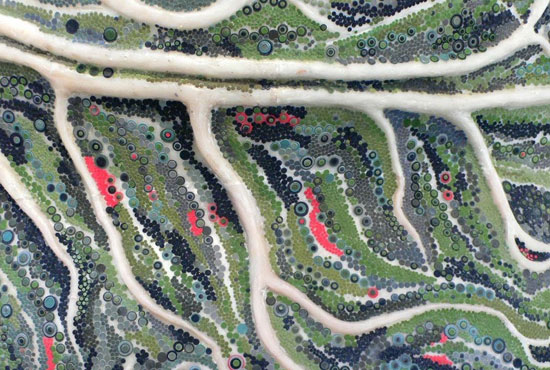
detail of bindis in 'the nemesis of nations'

kher uses the ready-made bindi as a central motif of her practice.
this tiny decoration is used as a means of transforming objects and surfaces.
her use of the bindi brings to her art a range of meanings and connotations
across historical and contemporary periods.
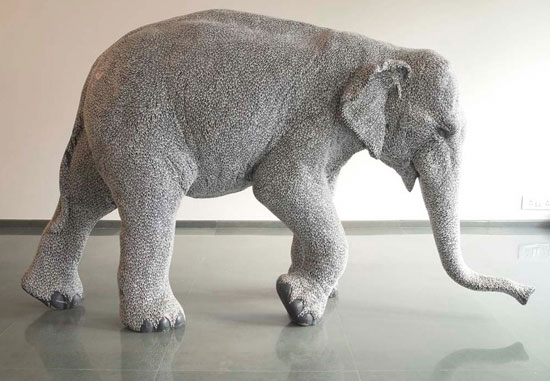
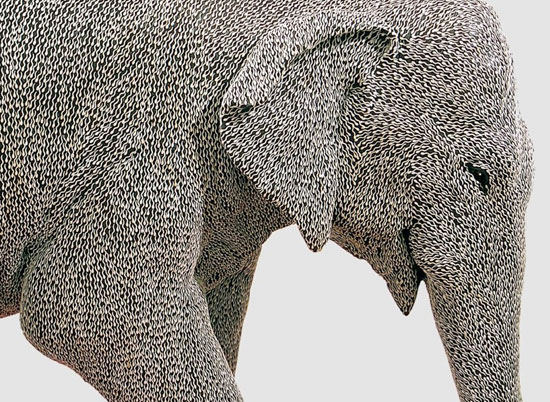
she is known for her menagerie of resin-cast animals, which are covered
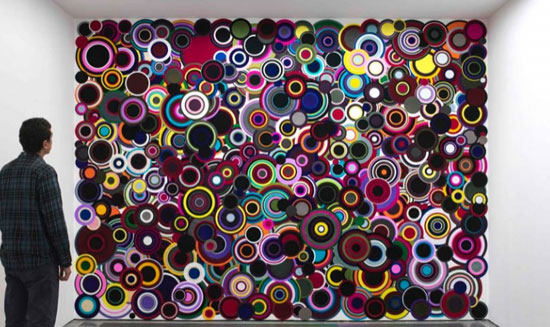
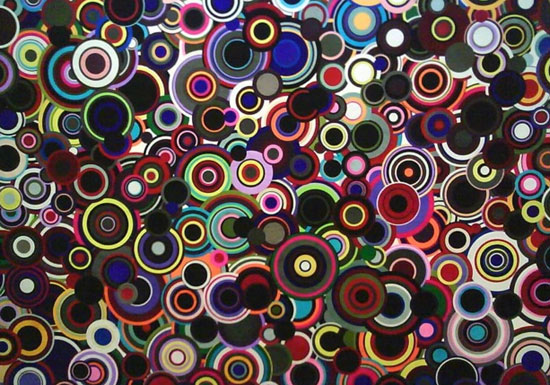
with the bindi, and she also uses the bindi to make large, wall-based panels.
these sensual abstract surfaces may be described as swirls of contrasting
colored dots and shapes. when not working with the bindi, kher’s practice
encompasses digital photography and sculptural works that continue to explore
her interest in kitsch and popular consumer culture.
in kher’s work, the bindi transcends its mass-produced diminutiveness becomes
a powerful stylistic and symbolic device, creating visual richness and allowing
a multiplicity of meanings.


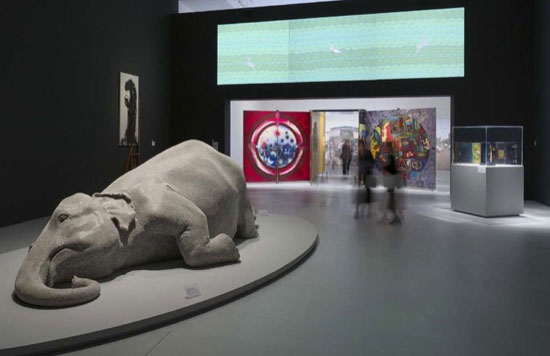
'I've seen an elephant fly', 2002
life-size of a baby elephant, fiberglass and bindis


detail of bindis in 'I've seen an elephant fly'


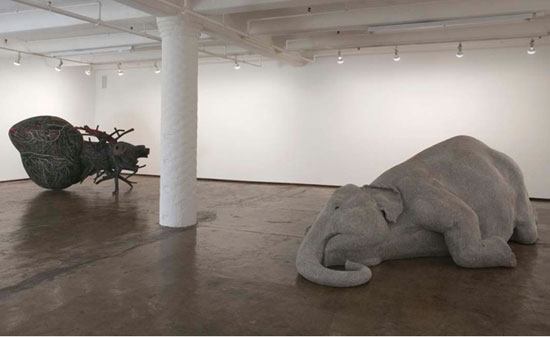
view of the exhibition 'an absence of assignable cause'
in 2007 at jack shainman gallery, new york

www.jackshainman.com


right: 'the skin speaks a language not its own', 2006
life size of an elephant, fiberglass and bindis


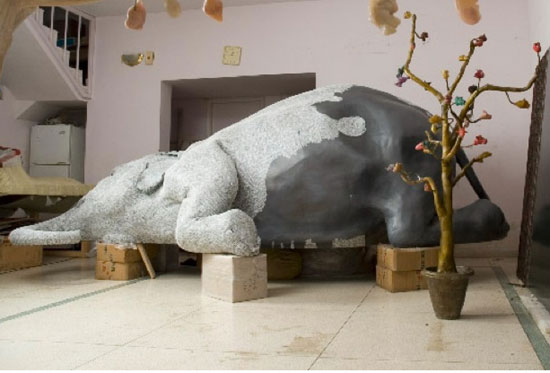
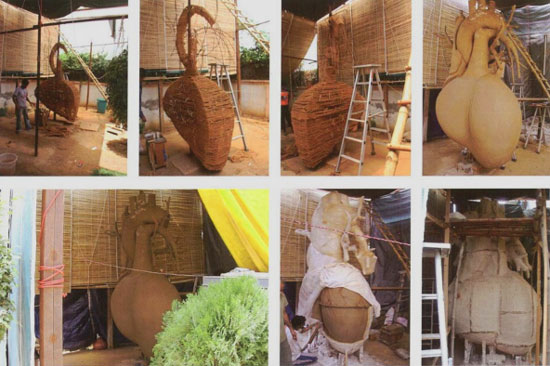
the making of 'the skin speaks a language not its own'
bharti kher's studio view,
photo © anup sood


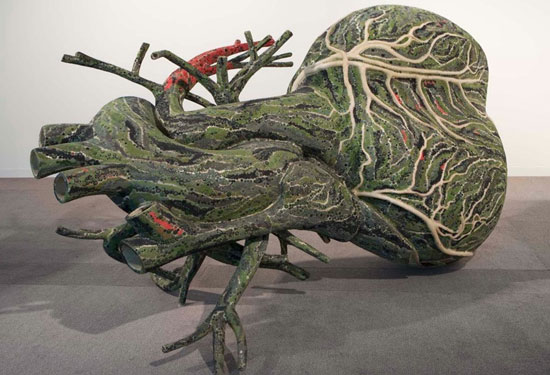
'an absence of assignable cause', 2007


detail of bindis in 'an absence of assignable cause'


the making of the 'an absence of assignable cause' sculpture


view of the exhibition 'chalo! india:
a new era of indian art' at the mori art museum in tokyo, 2008/2009

bharti kher was born in 1969 in london and was educated in painting
and design at newcastle and middlesex polytechnics.
since 1993, she lives and works in new delhi, india.

Bikash Bhattacharjee


Bikash Bhattacharjee was born in Calcutta in 1940. At a very early age he lost his father and the growing up years were one on struggle. Form his early childhood, the rooftops and alleyways of north Calcutta where he lived, the crumbling walls of buildings, the variety of people living there wove a certain magic in his mind. In 1963, he graduated from Indian College of Art and Draftsmanship. He began teaching at Indian College of Art and Draftsmanship in 1968. Later from 1973, Bhattacharjee began teaching at the Government College of Art & Craft and taught there till 1982. In 1964, he became a member of the Society of Contemporary Artists.
Besides painting the city and its people that he knew so well, Bhattacharjee is also an accomplished portrait painter. Realism is Bhattacharjee's forte. In the process, he explores the possibilities of oil as a medium to the extent that he could depict the exact quality of drapery or the skin tone of a woman, the moldering walls of an old building as if by magic. He also achieves mastery in capturing the quality of light. His love of cinema had a lot to do with this. Bhattacharjee has also worked extensively with pastel.
The artist collaborated with writer Samwesh Bose and illustrated a fictionalized biography of artist Ram Kinkar Baij. The project was incomplete because of the sudden death of Bose.
At his best Bhattacharjee achieves an enigmatic quality in his paintings that works on many levels from the visual to the subconscious. Female beauty is a major preoccupation of Bhattacharjee. But he also creates a varied cast of characters in his canvases- old men and women, children, domestic help. The ability to create an authentic milieu as a background to the characters heightens the drama. Bhattacharjee also excels in his animal studies.
Bikash Bhattacharjee lives and works in Calcutta.
bikasbhattacharjee-1.jpg (6500 bytes)
Bikash Bhattacharjee
Untitled
Oil on canvas
32.6 " x 51.3"
1967
bikasbhattacharjee-2.jpg (9047 bytes)
Bikash Bhattacharjee
Ceremony
Mixed Media on paper
35.2" x 47"
1992
bikasbhattacharjee-3.jpg (10598 bytes)
Bikash Bhattacharjee
The Doll
Oil on Canvas
47.6" x 47.8"
1972
 

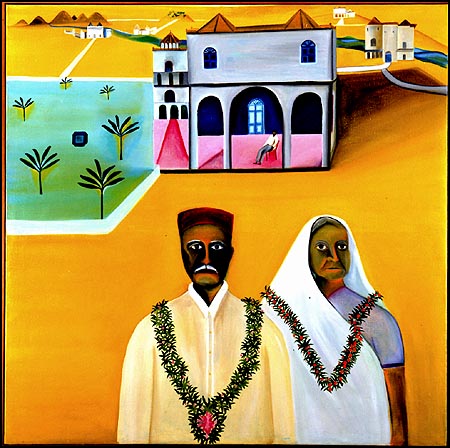
Bhupen Khakhar

An artist must be vulnerable

Leading Indian artist, Bhupen Khakhar, was born in 1934 in Bombay and his first professional career was as a chartered accountant. His career as an artist began in his late 30s. Described in a biography as ´possibly the most provocative painter in contemporary Indian art´, Khakhar evolved a visual language in his vibrant panoramic paintings that combined elements of traditional Indian art with contemporary themes. His open homosexuality was a controversial contribution to his career as an artist, providing subject matter and a challenge to galleries and curators, both in India and elsewhere. Khakhar received international acclaim through many major solo exhibitions, participation in group exhibitions and work in major world museum collections.
Bhupen Khakhar, was born in 1934 in Bombay and his first professional career was as a chartered accountant. In his 30s he began to feel dissatisfied with this path and, against the wishes of his family, he went to the School of Art in Baroda to study art criticism. He started to paint and first exhibited in India in the mid-1960s. Now regarded as one of India’s foremost artists, he has been described by Timothy Hyman in his biography on Khakhar as ´possibly the most provocative painter in contemporary Indian art´.

Khakhar was invited to teach at Bath Academy of Arts in England for six months in 1979 and this period led to a great affinity with Britain. He met the painters Howard Hodgkin and David Hockney, both of whom have informed and influenced his career. Khakhar received international acclaim long before his artistic strengths were acknowledged in India. Hodgkin helped organise a solo exhibition of his work in Britain at this time.

In the 1980s Khakhar came out as a homosexual and his work, which had started out with a strong pop art flavour depicting incidents from daily life, street market and temple in vivid colour, began to reflect the challenges posed by his sexuality. His early paintings, like Hockney’s work, revolved around the everyday ‘insignificant man’ trapped in an unremarkable existence. He also worked with his contemporaries in Baroda like Gulam Mohammed Sheikh to evolve a visual language that combined traditional Indian art elements with contemporary themes.

Bhupen Khakhar is viewed by many on the Indian cultural scene as ´an iconoclast and a maverick, a man who never did what was expected, and who was open about his views on everything, from sheer sectarianism in society to his homosexuality´ (from Saffronart profile).

After coming out, Khakhar’s work entered what he called his ´gay period´ in which he said, ´I tried to explore and represent the world of homosexuals as I know and understand it.´ His exploration of homoerotic themes is evident in paintings such as ‘You Can’t Please All to Yayati’ and ‘Two Men in Benares’. He was outspoken in his condemnation of social rejection of homosexuality in India where his open gay sexuality and homoerotic themes were viewed as controversial.

Khakhar acknowledged the difficulties this created in his career as an artist since there was a time when no gallery wanted to keep, exhibit or sell his work. Even today, his paintings are excluded from the collections of several galleries. ´The institutions have excluded my work not because they are scared of criticism, but because my work speaks volumes of the absence of any identifiable career in society. Society’s failure to provide such a culture is the theme of my paintings.´ Some of the work is very explicit – homosexual acts depicted in the most gorgeous, rich colours in real and mythological contexts, clearly drawing on India’s Hindu erotic art, and its blatant good humour.

Bhupen Khakhar moved into a more assured and settled period in his later years, working on a series of paintings in Ahmedabad, India’s former industrial mill city known, like Manchester, for its textile history. He lived and worked in Baroda and was touched by the communal violence between Hindus and Muslims in his home state of Gujarat in the early 21st century. He made a number of large works in oils and watercolours commenting on these increased tensions which were exhibited in Manchester in 2002/03 at The Lowry in a major retrospective show organised by the Museo Nacional de Arte Reina Sofia in Madrid.

In his late 60s, Bhupen Khakhar again explored the everyday themes of life in India – Kerala landscapes, roadside cafes in Tamil Nadu, a collage of images of life around a mosque. His work, essentially representative, references Indian miniature paintings, plays with perspective and draws the viewer into spiritual dimensions through a vertiginous saturation of colour.

Bhupen Khakhar was awarded the prestigious Padmashree award by the Government of India in 1984. His work is widely exhibited internationally and included public commissions. It is found in museum collections in India and around the world, from the Museum of Modern Art in New York to the Victoria and Albert and British Museums in London.

SOURCES: Artist’s profile on Saffronart website (www.saffronart.com); review of exhibition at The Lowry in Manchester Online.
Author: Judith Staines