Bharti Kher
|
Born 1969 in London, UK
Lives and works in New Dehli, India
Working with sculpture, photography
and painting, Bharti Kher explores issues of personal identity, social
roles and Indian traditions but also from a broader perspective, 21st
century issues around genetics, evolution, technology and ecology.
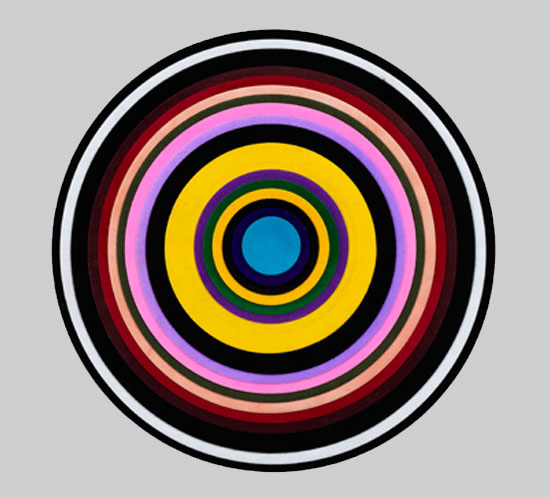
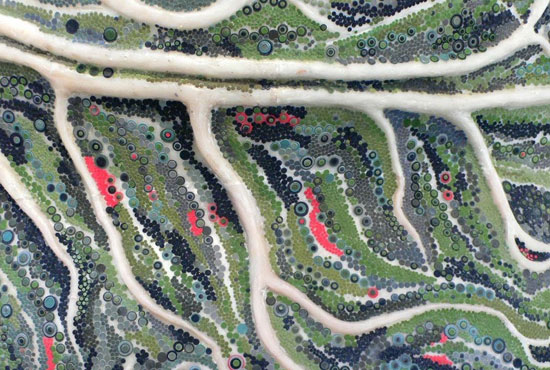
Kher uses the bindi as a central motif
in her work, transforming the surfaces of both sculptures and paintings
to connect disparate ideas. The bindi is a forehead decoration
traditionally made with red pigment and worn by Hindu men and women. It
represents the ‘third eye’ the all-knowing intrinsic wisdom and is a
symbol of marital status. Recently bindis have been transformed into
stick-on vinyl, disposable objects and a secular, feminine fashion
accessory. In Kher’s work, the bindi transcends its mass-produced
diminutiveness becoming a powerful stylistic and symbolic device,
creating visual richness and allowing a multiplicity of meanings,
including tensions inherent in shifting definitions of femininity in
contemporary India.
Kher’s early figurative paintings
explore a female perspective of modern India's patriarchal society
through representations of contemporary Indian interiors. Depicting a
pluralism with ancient Indian customs juxtaposed with modern Western
values, Kher reveals how, while increasingly receptive to foreign
influence, many Indians still remain reverent of their own culture in an
overtly conspicuous fashion. This clash of cultures is very apparent to
Kher - a British-born child of the Indian Diaspora who has, in contrast
to dominant outward migration trends, moved to India as an adult.
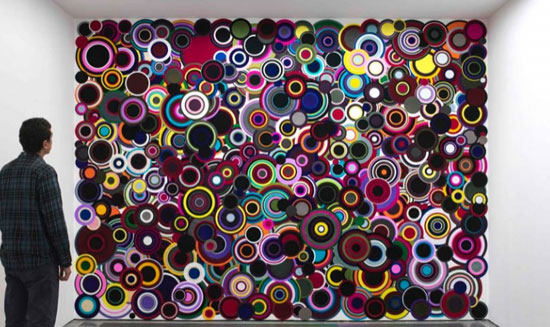
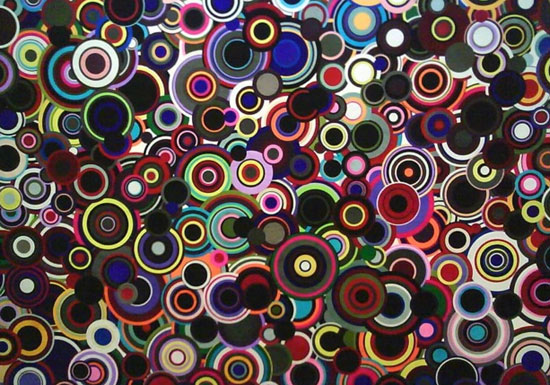
Recently her panel paintings have been covered with thousands of bindi
creating abstract arrangements encoded with patterns of exile,
immigration, crossing boundaries and the passage of time.
In response to repressions towards
women in India, a number of works by Kher denounce domestic tyrannies
that define many women’s lives. In The Girl with the Hairy Lip said No,
2004, Kher disrupts a table laid for a tea-party with broken chinaware,
false-teeth and a hair-lined cup, at once critiquing both the English
custom of afternoon tea and the Indian bride-viewing tea rituals for
arranged marriage ceremonies, with reference to Méret Oppenheim’s
surrealist fur lined tea cup.
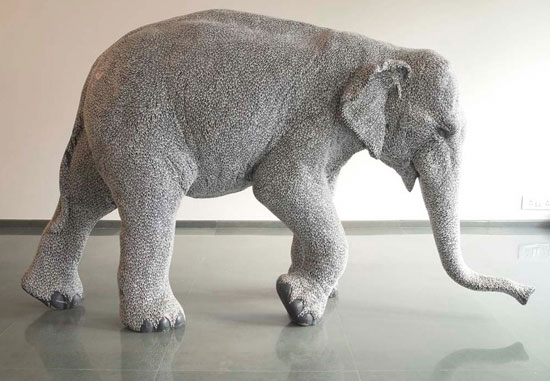
Animals are another recurring theme in
Kher’s work, serving as a metaphor for the body and transformation.
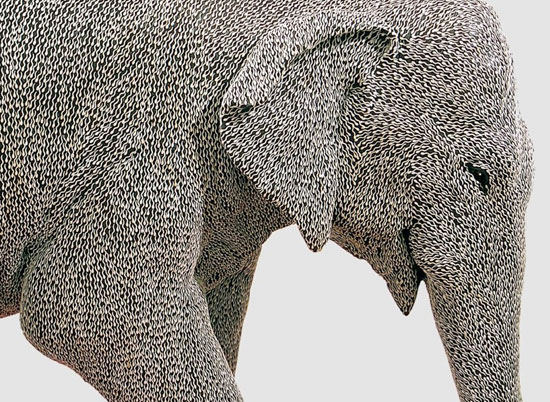
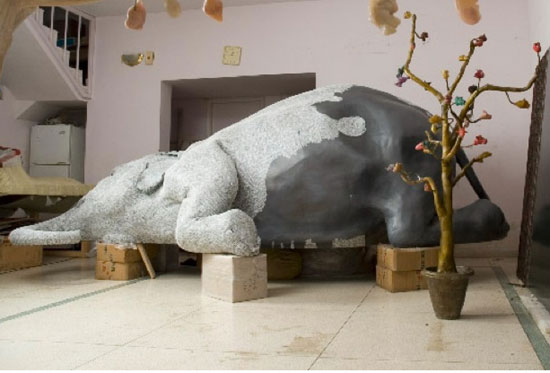
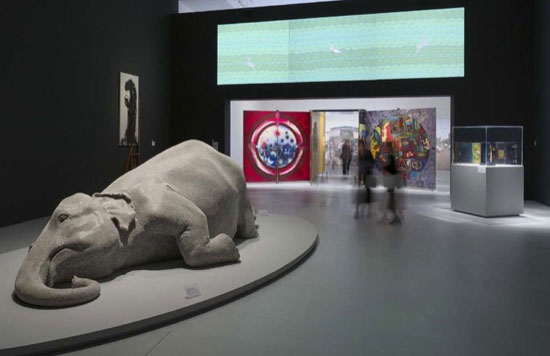
I've seen an elephant fly, 2002, is a hyper-realistic, life-sized
fibreglass sculpture of a grey elephant, covered with white sperm-shaped
bindis. While in Buddist and Hindu mythology the white elephant is
sacred, in the West, it is a metaphor for something frivolous and
useless. In I've seen an elephant fly, grey skin is clearly visible
behind a white covering, which emphasises the second skin, thereby
confusing its identity and value. Kher poses questions about her own
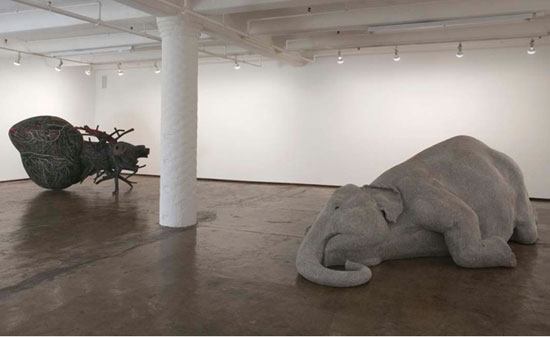
complex identity. In The Skin Speaks a Language Not Its Own, 2006 the
elephant reappears as a pathos-inducing figure leaving the viewer unsure
whether death or recovery is the next stage. This exploration of
‘inbetween-ness’ with an absence of cause and reason are recurrent
themes for Kher.
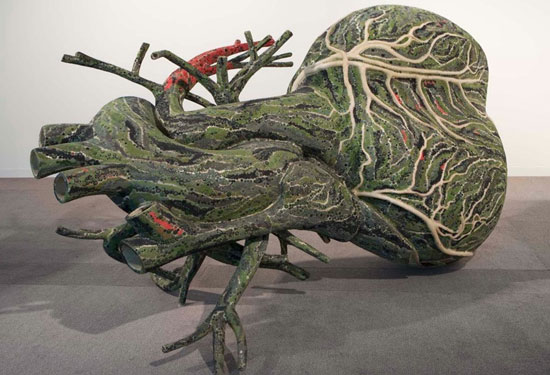
In the sculpture Solarum Series, 2007
Kher returns to the natural world. The tree, a potent symbol that
appears in ancient mythologies from many cultures Kher uses such
references and combines them with contemporary references,
likebiological cloning. The branches of Solarum Series bear the heads of
hundreds of creatures: a disturbing and dystopic vision of a
genetically engineered hybrid.
Rebecca Morrild |

Bharti Kher
An Abscence of Assignable Cause, 2007
|