Monday, 17 September 2012

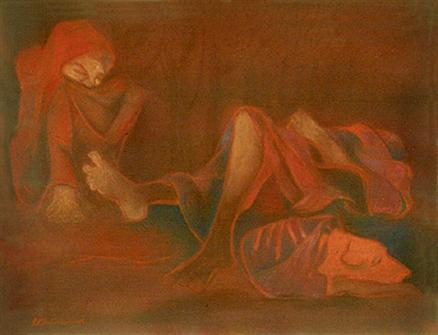
Manjit Bawa

Manjit Bawa is yet another well known painter of India. He was born in 1941 in a small town called Dhuri in Punjab. As a child, Manjit was not really encouraged to be an artist. His mother would often deject him saying that art cannot fetch one a living. However, painting and art was where Mantis’s heart lay. He had no doubt about becoming an artist. Manjit always believed that art should bring some freshness with it. It should portray something that one has never seen before.

Manjit’s elder brothers supported him and motivated him to further his career in art. From 1958 to 1063, Manjit studied fine arts at ‘The School of Arts’, New Delhi. His professors were his source of inspiration then. Bawa gained an identity under the great Abani Sen, who pushed him to make almost fifty sketches a day but most of them were rejected. As a result, Bawa started to work even harder for longer hours.

His passion for painting immerged and grew with each passing day. Manjit started to admire and move towards the figurative art when most of the art world was in favor of the abstract works. He truly credits his teachers and Sen without whom he believes that he wouldn’t be able to create such styles that we see in his work today. Bawa studied art as well as worked as a silkscreen printer in Britain from 1964 to 1971. After returning from Britain, Bawa was in a fix as he could not figure out what should he paint. Bawa just did not want to be typical European style painter. In his childhood, Bawa was exposed to a lot stories from Indian mythology like the Mahabharata and the Ramayana He had also been taught a lot about Sufi poetries. He brought these to his paintings.

Manjit Bawa's canvases are very discernible in their colors especially the yellow color of sunflowers, the green color of the paddy fields, red of the sun and the blue of the mountain sky. Bawa opted for more traditional Indian colors like pinks, reds and violet. He was one of the first painters to break out of the clichéd grays and browns. Initially there was a lot of criticism on Bawa’s work but he still persisted his own way. Manjit believes that bright colors are closer to the heart of most Indians. They are also familiar with the shades of bright colors.

Nature has inspired Bawa to paint the countryside landscape. As a young boy, Bawa would travel by foot or hitch hike to places like Himachal Pradesh, Rajasthan and Gujarat. He would then spread his sheet pf paper and draw beautiful landscapes. The colors and the simplicity of people fascinated him a lot. One would always find birds and animals in his paintings. Besides nature, flute was something that one would get to see in his paintings often.
The main charm of his paintings is the feel that one gets of saturating expanse of color fields which create space and define the curves of figures. Manjit Bawa lives and works in his studio in Himachal Pradesh, and also in Delhi, where his family lives.

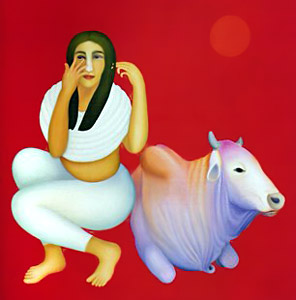
Rameshwar Broota

R Broota is one of the talented painters of modern India. He was born in 1941 in New Delhi. He graduated from the college of art in 1964. Broota has been teaching and inspiring many students and art lovers as the head of the department of art, Triveni Kala Sangam, New Delhi. From the very beginning of Broota’s career, he has been passionately involved in the human situation that degrades individuals. As a young painter Broota's anger at the sufferings of the poor and the anguish at the voracity and corruption that he saw in society was eminently expressed in his early works which are a sardonic and bitter comment on the social society. Slowly Broota's creativity gave a new direction to aesthetics in contemporary Indian Art. His canvasses are usually large but on close observation, they are enormously obscure monumental drawings. Broota’s present works has had an abstract bent with symbols communicating the cadence of time, of man, and of existence.
Broota’s solo exhibitions were held in 1984 and 1990 at Calcutta and also at Mumbai in 1997. By choice, Broota never had a solo showing of his paintings in Delhi though. In 1980, 1981 and 1984, the painter has won three National Awards of the Lalit Kala Academy. He has also won the AIFACS Awards in 1973 and 1975 and the Hyderabad Art Society Award for Graphics in 1976. He received the Senior Fellowship of the Government of India for the years 1987 and 1988. In 1988, he was bestowed the L. N. Gupta Memorial Award and the Title Award 'Kala Vibhushan' by AIFACS in 1997. Broota has also made some experimental video films which were highly acclaimed too.
Broota mostly paints in the monochrome technique. His canvas surface is usually painted in matte black. He works with a sharp and thin blade so as to bring in light and forms. This exposes the white surface below giving it a lovely effect and creating deep spatial dimensions His highly fine paintings have the quality of a graphic print.
His paintings have been shown in many solo and prestigious group shows. Some of them include the 'Pictorial Space' which was held at New Delhi' in 1977. He achieved world wide recognition with his exhibition at the Museum of Modem Art, Oxford in 1982 with the theme being India: Myth and Reality. Apart from that, his work was also exhibited at the Hirsch horn Museum in Washington D.C in 1982 u7nder the title ‘Modern Indian Painting'. Other famous exhibitions were his work was included are the ‘Biennales’ in Tokyo and Dhaka, 'Art for Man', Saddam Centre for International Art, Baghdad in 1986 and International Art Fair in 1976. Broota basically lives and works in New Delhi.
Broota is not only a good painter but a great teacher too. Broota has been giving guidance and inspiring many artists of the younger generation.


Tyeb Mehta

Tyeb Mehta: The legend of modern Indian art

For those who are not familiar with his name, Tyeb Mehta (b.25 July 1925 - d.2 July 2009) was one of the greatest Indian painters from post Independence era (post 1947), highly celebrated and recognized worldwide for his figurative paintings. He was associated with the renowned Progressive Artists’ Group of India. His paintings are known for their trademark luminous colors, powerful subject matter and expressive brushwork.


In India, sadly, we do not have many art museums dedicated to modern art with permanent exhibits. We have public galleries where if you are lucky you get to see some fantastic shows once in a while. I remember one such exhibition from around 12 years back which was showing works by really big names from the world of modern art in India. The names were familiar to me having studied about these artists in my art school curriculum. 
So there I was, walking very quietly, almost religiously, moving from one painting to another, very conscious of the big names behind the paintings, feeling respectful at a distance. But when I came to a painting by Tyeb Mehta, I felt compelled to go closer and preen at the exotic work before me, mesmerized by the vivid and stark colors that he had used. His paintings were completely different from what I had perceived them to be, based on their prints. Thereafter I rarely missed an opportunity to see his work. ( The opportunities were very rare though :-( ) 


Tyeb Mehta’s paintings have a mystic paradox of subject and application. While subjects strongly echo human suffering, trauma, violence and agony, the painting style is highly composed and structured. He would have easily taken the ‘gestural’ path and it would have been logical at that time. But it looks like he had sort of compartmentalized the subject matter from the style and a strong artistic assurance of discoveries shows through in his work. He was a quiet observer who loved solitude and loved reading. Not surprisingly, he formed his own powerful visual language which had its roots from Hindu mythology to modern historical events like partition of India and Pakistan. Pain and violence was observed, understood and finally rearranged in his own way. So, for example when a composition is based on some mythological story, it’s not laden with the usual pomp and ornaments, and when it is based on a bloody incident on the street, it does not display the cluttered realities of life. Everything floats between Tyeb’s artistic pursuits and the viewer.


Tyeb’s color palette is full of astonishing bright colors, as if picked from flocking colorful market streets. Neither do they replicate any pre-established, well received set of colors, nor do they intentionally project an ‘Indian-ness’. They appear to be an outcome of his personal artistic quests. He painted large solid plains with pure hues of oil paints most of the time. The colors in his paintings engulf the viewer in their span, almost hypnotizing, and when the viewer gradually floats out of these hues, he finds himself facing the brutal subject that the painting is talking about. It is like seeing the painting inside out! It is one indescribable experience and I will strongly recommend you to view Tyeb Mehta’s work when you get a chance.

Jehangir Sabavala

Jehangir Sabavala (1922 - 2011) R.I.P.


Jehangir Sabavala (1922 - 2011) R.I.P.

One of the prominent figures from Indian art scene Jehangir Sabavala passed away on 2nd September 2011 at the age of 89. He was extremely active as an artist till recent and was known to work on his paintings for long hours. He has produced numerous works which can be classified into various art styles, and which had emerged from his subtly evolving artistic phases. But to speak broadly, he was an academic easel painter who seemed to enjoy the warm relationship with canvas and colors throughout his long career. His style had a strong cubist influence perhaps inherited from his decade long academic stay in Europe in late 40s and early 50s.

For the sake of conveying a better idea of his work, I would say that his paintings give a feel similar to that of Robert Delaunay or Lyonel Feininger.

Born in a highly esteemed Parsi (Zoroastrian) family from Mumbai, after an initial art education in India, Sabavala spent his long academic tenure in prestigious art institutions of Europe such as the Heatherley School, the Academic Andre Lhote, the Academic Julianfrom and the Academic de la Grande Chaumiere in Paris. He was often described as ‘a gentleman’ of Indian art scene, and his grace and elegance also reflected in his painterly brush work and marvelously subtle tones. Sabavala participated in numerous exhibitions, solo shows and represented India in various international shows like Venice Biennale. His works have been collected by museums worldwide and are often seen in important group shows that cover the last 50 years of art in India. Sabavala was awarded the prestigious civilian award ‘Padma Shree’ by the Government of India in 1977.

Sabavala had witnessed and had also been a part of the critical art timeline of India. Before India gained its independence in 1947 from the British colonial rule, modern art education had been introduced in India, like many other educational streams, as a part of the educational policy (designed for ‘natives’ by subject experts). It had been established in rush and never got a chance to organically evolve in that short period. But post independence, things changed rapidly. Two types of artists were seen active in those years, the ones who remained academic and explored within the boundaries of conventional easel work, or the artists who tried to adapt bohemian lifestyle and worked similarly. Clashes and criticisms were inevitable between these two loose categories of painters but all these conflicts ultimately helped the art in free India to move forward and evolve. Jehangir Sabavala’s contribution to the Indian art will remain indisputably important in this respect.

Krishan Khanna

Krishen Khanna is one of the distinguished names in the Indian contemporary art scenario. Along with his friends M.F. Husain, Tyeb Mehta, Ram Kumar, Raza, Souza, Gaitonde and others; Khanna started painting at a time when there was not much glitz in art. He was born in pre partition India in 1925 in the Lyallpur district (now in Pakistan). He then moved to Shimla during the partition era. In Lahore, Khanna attended evening classes at the Mayo School of Art. After coming to India, he took up a job with Grindlays Bank and was placed in Mumbai. But he gave up a job in Grindlays Bank to pursue art about four decades ago. During that time the art scenario was much different and enclosed than what it is now.  His ardor for art motivated him to take such a step. His hard work, perseverance and interest won him many rewards and accolades in the art world. Krishen Khanna has also taught art in the United States without any formal academic qualification in the subject. The artist's sympathy towards the browbeaten and poor people is vivid in his paintings. . Depiction of violence and can also be seen in Khanna’s work coming from his experiences during the Partition.

Khanna sold his first painting in a major exhibition in to Dr. Homi Bhabha for the Tata Institute of Fundamental Research. His father always encouraged and supported him to pursue art as a career. In fact his wife also supported him when he resigned from the job. Khanna shows and exhibitions in Mumbai were very well received and this boosted up his confidence. Khanna was also invited to join the Progressive Artists' Group with whom he remained involved for the rest of his time.
In 1962, Khanna was awarded the ‘Rockefeller Fellowship’. In 1963-64, he was ‘the Artist in Residence’ at the American University in Washington. Apart from several solo shows, he has participated in group shows like the ‘Tokyo Biennale’ in 1957 and 196 1, the ‘Sao Paulo Biennale’ in 1960, ‘the Venice Biennale’ in 1962, and several others. Khanna has held many vital positions in decision-making bodies of the Lalit Kala Academy, National Gallery of Modern Art and Roopanker Museum, Bhopal. In 1996, he was awarded the grand ‘Padma Shri’.
Khanna does not prefer the cornucopia of figuration which was so evident in Indian paintings. Khanna makes such an incredible impact on the canvas that it sure leaves a dint in the on-lookers heart. His masterful maneuver of painting evokes the unmatched feelings of human situation. The thick impasto façade of the painting often seems like a prism through which figures can be distinguished. Khanna relocates his observations onto the canvas with such naturalness and exuberance that it enhances his subject matter. His earlier works are replicas of scenes that have imprinted themselves on his mind during the partition. Khanna lives and works in New Delhi.

V.S. Gaitonde

Achievements of Vasudev S. Gaitonde

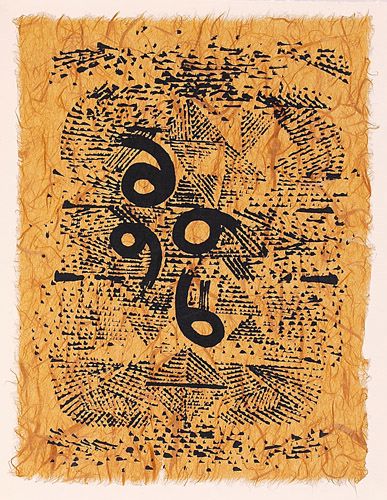
Achievements of Vasudev S. Gaitonde Vasudev S. Gaitonde was considered as one of the cloistered and best abstract painters of India. He impressed the members of the Progressive Artists Group of Bombay and was called upon to be a part of the group. He turned to be an active member of this group. There are a number of exhibitions to his name both in India and foreign countries. He never supported the collective but backed an individual; it was the key feature of his artistic creativity. A strong belief in his individuality as a painter was accompanied by his non-conformist nature. He made himself secluded at a very early stage of his career from things in his surroundings. He referred to these things as extraneous to his self as a painter. His development over the years is marked by a mounting inwardness and a painstaking and attentive consolidation of this individuality. Vasudev.S. Gaitonde was the first contemporary Indian painter whose work fetched INR 92 lakhs at the Osians art auction. Achievements of Vasudev S. Gaitonde are considered amongst India's foremost abstract and ethereal works of art.
Early Life

Vasudev S. Gaitonde was born in Nagpur, Maharashtra in 1924 to Goan Parents.

Education and Career

V.S. Gaitonde received his diploma from Sir J. J. School of Art in 1948 with the fellowship of a globally reputed painter from Goa, Francis Newton Sousa. He contributed a lot to the 'Progressive Artist Group', with an extensive responsiveness to split away from the past. He aimed at an approach repressively weighed down by colonial academism and corny Indianess. Also he targeted to prepare a way for a worldwide idiom. This progress put modern art into perspective and set a velocity for vibrant art ambiance in India in the present day and age.

Style

V.S. Gaitonde made great experiments with shape and form in his works. Otherworldly and diverse paintings of Gaitonde appeal to an obscure and concealed description of the genuine world. The artist, however greatly ignored the name of ‘abstractionist’ conferred upon him. Very deep impact of ancient calligraphy and Zen philosophy is visible in his artworks. Amidst his creative compositions on canvas, you can see the conglomerated and controlled surface depicted in a fine manner. Whereas the contemporaries of Gaitonde did not take pleasure in meticulous and slow paintings, Gaitonde enjoyed the same. This is the reason why the number of his fashioned works is a little. He has used symbolic elements and very less ground lines. This has turned his works flawless. A look at his works makes art aficionados think of artists like Joan Miró and Paul Klee. He did his studies under these artists during his college days. Admirers of V. S. Gaitonde used to address him as a painter of quite reaches of the imagination. He is one of the ultimate emergences of brilliant and simmering artist having some undiscovered thought in his mind. He never conceptually refereed himself as a painter who deals in abstraction. On the other hand he addresses his artworks as non-objective which is a kind of calligraphic inventions and personalized hieroglyphics. They evoke the surface painted on with the most astounding intuitions. The thoughtful Zen quality becomes obvious in his language. Emoting calm is best exemplified in his works because peace is meaningful and eternal in itself. It is from this point that one tends to make out the inexplicable motifs, the highly tailored and adapted hieroglyphs in Gaitonde`s canvasses along with the expression of intuitions that are invested in.

Awards and Accolades

It was in the year 1956 when he took part in the Indian art exhibition. This exhibition was held in east European countries. He was also a part of group exhibitions held at the Graham art gallery, New York in 1959 and 1963.
A number of Indian and foreign collections display abstract works of Vasudev S. Gaitonde that include the Museum of Modern Art in New York. At the Young Asian Artists Exhibition at Tokyo he was given the first prize in 1957. He received the Rockefeller Fellowship in the year 1964. It was in the year 1971 when he was awarded the Padma Shri which is the highest award for artistic excellence bestowed upon artists by the Government of India.
Achievements of Vasudev S. Gaitonde showcase his unparalleled ingenuity. He makes the viewers just fix their eyes on at his artworks. His paintings correspond to a spectacular fantasy of color, form, and painting as well. This artist has the talent to make uncomplicated objects to turn into sacred elements. V. S. Gaitonde had incredible talent and dexterity in shading. This makes his work appear like a never ending chasm. He widely makes use of a palette knife and a roller, to methodically manipulate and blend various mediums on the canvas. His works of art seem to sublime with every element which evaporates in one or the other form. His abstract paintings with their simple beams of light stir up concealed profundity. His art work appears to glow with a contemplative allure with huge planar surfaces and delicate layers of paint on the canvas. His paintings carry an aspect of light which seems to be comprehensive in it. His work crafts up tinctures and later on they are cautiously detached for the preferred achieve that is always created by V. S. Gaitonde. He breathed his last in 2001.

Ram Kumar


Ram Kumar is one of the post colonial contemporary artists of India. He was born in 1924 in Shimla and he achieved his master’s degree in economics from St. Stephens College, Delhi University. Ram Kumar use to take painting classes at the Sharda Vakil School of art and was noticed by the famous painter S.H.Raza who later became his close friend.  In1952, Kumar went to Paris to study painting. He received the JD Rockefeller fund fellowship in 1972. Ram Kumar is also a great writer. He was well known for his short stories in Hindi. The Govt. of India awarded him the ‘Padmashree’ in 1972.  In 1985, he was awarded the ‘Kalidas Samman’ by the Madhya Pradesh State Govt. Ram Kumar lives and works in New Delhi. At Paris, Kumar took guidance under Andre Lhote and Fernard Leger between 1949 and 1952.
With the ever increasing global interest in the Indian contemporary art, Ram Kumar’s paintings too have gained appreciation in the booming art market. Ram Kumar has had numerous solo exhibitions including the International Biennales in Tokyo in 1957 and 1970, the Venice Biennale 1958 and in Sao Paulo in 1961, 1965 and 1972.  He has also participated in the Festival of India show held in the former USSR and also in Japan in 1987-88. Ram Kumar has also received the prestigious ‘Prem Chand Puraskar’ from the Uttar Pradesh Government for ‘Meri Priya Kahaniyan’ which was a collection of short stories.
Ram Kumar’s early work specifically manifests the typical human conditions. He typically depicts the estranged individual lying alone amidst the city. His work specifically portraits the city Varanasi and its decrepit and crammed houses. His paintings give the on looker a sense of hopelessness and despondency. With uneven and sweeping strokes of paint; Kumar stirs up a sense of ecstasy of spaces. His recent work portrays the embryonic hostility within human environment.
Kumar demonstrates the innermost dramas of Indian culture while still maintaining his eccentricity and distinctness. Ram Kumar maintains the idiosyncrasies in his work by depicting the art of reminiscence. Ram Kumar relinquished his engagement with the state and civil society which claimed to characterize his position. The artist prefers to turn inward; choosing to be an inside expel of the soul. Ram Kumar’s recent paintings have been an aesthetic kind of reconciliation. The severity of the structure and the intensity of the brush strokes evoke the universal rhythm of art creation in Kumar’s paintings. The uncommunicative silence of Kumar’s paintings in a way screams to the onlooker. The journey of Kumar’s art has been an experience like that of the flowing river, moving graciously from festive expressivity to menacing reticence. The true subject of Ram Kumar’s art is perhaps the sensuousness of the beautiful landscapes that he creates in his paintings. His landscapes are usually done in oil or acrylic. In the truest sense if the term, Ram Kumar has indeed been one of the brilliant twentieth century modern painter.