| Paramjit Singh Some
contemporary Indian painters have found landscape painting as a genre suitable for
expressing the esoteric and the outr6. For them the phenomenal world hides something more
than what is immediately perceived. Paramjit Singh's hills and woodlands carry the
luminous memory of a transcendental presence. Born in 1935 in Amritsar, Paramjit Singh had his art education in the School of Arts, Delhi Polytechnic (1953-58). He was the founder member of 'The Unknown', a group of young painters and sculptors based in Delhi. Paramjit landscapes, with their loaded silence evocative of the other worldly, became over the years, a distinct mystical utterance in pictorial terms. The esoteric in his landscapes was perhaps young Paramjit response to the mystery in tensions between the deep pictorial space and the sharp shadows of inanimate objects in the picture metafisica, a short-lived school in modem Italian art, and to the later Surrealist paintings. All these were transformed over about two decades into a personal statement in Paramjit's paintings. From around the late 80s, Paramjit's landscapes and his 1 techniques changed radically. The Italian picture metafisica with their sharp shadows and melting tones receded into oblivion, and there emerged lush Indian landscapes with a mystical vision of a transcendental presence. Paramjit Singh won the National Award in 1970. Between 1967 and 1994, he had 24 solo shows in India and in important galleries and art centres in Norway, Germany and Belgium. In 1973 he worked in the graphics studios of the Atelier Nord, Oslo. He was a faculty member of the Department of Fine Art, Jamia Milia Islamia, New Delhi, for 29 years, and retired as Professor in 1992. Between 1957 and 1994, Paramjit participated in 48 important exhibitions in India and abroad, which included the First Young Asian Artists Exhibition, Tokyo (1957), Art Expo '70, Indian Pavilion, Osaka, Exhibition of Prints, Atelier Nord and Gallery '71, Tromso, Norway (1 973), Indian Art Today, 1Yarmstadt, Germany (1982), the 15th International Biennale, Tokyo (1 984), Inaugural Exhibition, Bharat Bhavan, Bhopal (1984), Art Biennale, Ankara, Turkey (1986), Festival of India, USSR (1987), International Festival of Art, Baghdad (1988), 'Indian Encounters', The Galleria, London (1 993), Art Biennale, Cairo (1994), Art Festival, Israel (1994). In twenty years, between the '70s and '90s, Paramjit Singh took part in eight artists' camps in India and one in Thailand. His paintings came under the hammer at seven important art auctions in India and at Christie's in London, and at the auction by Vadehra Art Gallery, Delhi-London, in 1994.In 1988, Paramjit Singh was the Commissioner for the Indian participants in the Art Festival of Pakistan, Lahore. He painted 450 sq. ft. area for an environmental room in Bombay in 1990-93. Paramjit Singh lives and works in New Delhi. |

Paramjit Singh
The Boat Oil on Canvas 36" x 46" 1974 
Paramjit Singh
Moonlight Oil on Canvas 30" x 36" 1986 
Paramjit Singh
Purple Ridge Oil on Canvas 62" x 69" 1989 |
Wednesday, 2 January 2013
Paramjit Singh

Indian artists
Indian artists
Suddenly Indian artists have made big splash in the global art mart. The number of success stories at auctions and art galleries aboard indicate art appreciation is on the upswing. Individual unique styles have been the USP of many success stories. Even the earlier artists’ works have found patronage the world over. As art creates a niche, a world of its own to hold Indian creativity of spiritual art is blending well with modern art.
Early Beginnings
Most art historians agree the earliest seeds of modern art were sowed with the emergence of Raja Ravi Varma’s (1848-1906) mythological oil paintings, the first in the country. He was the first to learn oil painting at the court of Maharaja of Travancore by a visiting European painter. This was in the beginning of the 20th century also called the revivalist art era. The Bengal school of art was speared headed by the affluent family of Tagores. They revived the ancient art of India. They concentrated on the mythological figures of Godhead, recreating the cave paintings of Ajanta, and the art of Mughal India. Rabindranath Tagore, Amrita Sher Gill and Jamini Roy gave a new meaning to a nascent modern art. Rabidranath Tagore is most famous for his painting mother India (a hindu goddess with four arms with the map of India around her. At the age of 69 years he started to paint. He is considered best known poet and painter of India. Amrita Sher Gill could have remained abroad with her Hungarian father and Sikh mother. However, she wanted to feel the life in India and stayed on. Her paintings are worth in cores today.
A Step Forward
It was after independence that new artists emerged with distinct identity forging modern ideas. A Progressive Artists Group was formed by some enthusiastic men. Those in this group included K H Ara, F N De Souza, S K Bhakre, M F Hussain, H A Gade and S H Raza. Barefooted M F Hussain continues to create waves in India and abroad. Likewise, De Souza went on to London surprising critics of the society there. Raza was charmed by the romance of Paris and made a name there. However, Hussain continues to seek new avenues to progress in India itself and is prolific in his work of art. His grandiose plans of a museum in Hyderabad too are taking good shape. Although the Progressive Artists Group split and naturally faded away, the artists of the group were busy creating their individual styles. During the pre-independence period, Satish Gujral created historical themes as he was affected by the partition. He still sways in New Delhi and his paintings adorn the best of corporate and individual walls. In addition, with the new sounds that he hears (sometime ago he got back his sense of hearing) he is still honing his talents.
It was the Progressive Group, which helped newer talent to emerge out of the cocoon. The current crop of Indian artists in some way owns their expression of varied talent to many of the earlier artists who paved the way for them. Many known Indian artists today are able to have individual styles and are finding it easier to gain acceptance in society. A budding artist today can have a career with minimalist struggle if he gets tutelage under a known name. Some of the names dominating the Indian Art scene today also owe awareness to the rise of art galleries, which are promoting them. Various festivals in metros give a chance for artists of all genres, to display their talent. In addition, with the global interest of auction houses visiting Indian art events, the future is promising. Some of the names that dot the Indian art scenario today include M F Hussain, Anjali Ela Menon, Jitesh and Reena Kallet, Tayeb Mehta, Satish Gujral, Akbar Padmsee, Gaitonde and the list goes on. Each artist has evolved in an individualistic style and over the years has emerged as an icon in the art world.
Carrying the Brush Forward
Today’s artists have the help of art galleries, work studio of well-known artists and various courses for Fine Arts. With so much of opportunity, available talent is nurtured in many parts of the country. When artists of different schools of thought have been brought together, exchange of new ideas have helped to improve their own work. On line galleries, workshops in studios and amid nature, seminars and other art events are educating young artists to evolve on their own. Students go abroad on exchange programs and return enriched with fresh ideas.
Artists like Jogen Chowdhary, Anjali Ela Menon, successful couple Jitesh and Reena Kallat, Brinda Miller, Atul Dodiya, Shibu Natesan and Kahini Atre Merchant are being patronized by corporate and art galleries in a big way. There is total freedom of creativity and choice of themes for artist of every kind. Today’s artists need to have the right marketing strategies and media exposure to be well known. Being seen in the right circles, exhibiting in the right galleries, festivals are important too. Success follows almost instantly. In addition, to survive the artists to today have less to worry as long as they continue to have the special X factor to succeed. - By N A Nagpal
Nek Chand Saini
Nek Chand Saini (नेक चंद सैनी) is an Indian self-taught artist, famous for building the Rock Garden of Chandigarh, an eighteen acre sculpture garden in the city of Chandigarh, India.[2]
He hailed from Shakargarh region (now in Pakistan) of district Gurdaspur. His family moved to Chandigarh in 1947 during the Partition. At the time, the city was being redesigned as a modern utopia by the Swiss/French architect Le Corbusier. It was to be the first planned city in India, and Chand found work there as a roads inspector for the Public Works Department in 1951. He was awarded the Padma Shri by Government of India in 1984.
In his spare time, Chand began collecting materials from demolition
sites around the city. He recycled these materials into his own vision
of the divine kingdom of Sukrani, choosing a gorge in a forest near Sukhna Lake
for his work. The gorge had been designated as a land conservancy, a
forest buffer established in 1902 that nothing could be built on.
Chand’s work was illegal, but he was able to hide it for eighteen years
before it was discovered by the authorities in 1975. By this time, it
had grown into a 12-acre (49,000 m2) complex of interlinked courtyards, each filled with hundreds of pottery-covered concrete sculptures of dancers, musicians, and animals.
His work was in serious danger of being demolished, but he was able to get public opinion on his side, and in 1976 the park was inaugurated as a public space. Nek Chand was given a salary, a title ("Sub-Divisional Engineer, Rock Garden"), and a workforce of 50 laborers so that he could concentrate full-time on his work. It even appeared on an Indian stamp in 1983. The Rock Garden is still made out of recycled materials; and with the government’s help, Chand was able to set up collection centers around the city for waste, especially rags and broken ceramics.
When Chand left the country on a lecture tour in 1996, the city withdrew its funding, and vandals attacked the park. The Rock Garden Society took over the administration and upkeep of this unique visionary environment. The garden is visited by over five thousand people daily, with a total of more than twelve million visitors since its inception.
An exhibition of Nek Chand's work also took place at the RIBA gallery in Liverpool, England from April 16 to May 11, 2007. The exhibition displayed survey drawings of the garden's architecture and landscaping, and plans to be a traveling exhibition.
There is a Nek Chand Foundation in London founded to raise funds for the garden.[3]
He hailed from Shakargarh region (now in Pakistan) of district Gurdaspur. His family moved to Chandigarh in 1947 during the Partition. At the time, the city was being redesigned as a modern utopia by the Swiss/French architect Le Corbusier. It was to be the first planned city in India, and Chand found work there as a roads inspector for the Public Works Department in 1951. He was awarded the Padma Shri by Government of India in 1984.
Contents
Contents
- 1 The Rock Garden
- 1.1 Gallery
- 2 Exhibitions
- 3 Further reading
- 4 See also
- 5 References
- 6 External links
The Rock Garden


His work was in serious danger of being demolished, but he was able to get public opinion on his side, and in 1976 the park was inaugurated as a public space. Nek Chand was given a salary, a title ("Sub-Divisional Engineer, Rock Garden"), and a workforce of 50 laborers so that he could concentrate full-time on his work. It even appeared on an Indian stamp in 1983. The Rock Garden is still made out of recycled materials; and with the government’s help, Chand was able to set up collection centers around the city for waste, especially rags and broken ceramics.
When Chand left the country on a lecture tour in 1996, the city withdrew its funding, and vandals attacked the park. The Rock Garden Society took over the administration and upkeep of this unique visionary environment. The garden is visited by over five thousand people daily, with a total of more than twelve million visitors since its inception.
Gallery
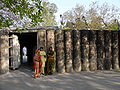
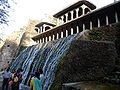


Exhibitions
Chand's statues have found their way into museums across the world, including an environment at the Capitol Children’s Museum in Washington, DC, the American Folk Art Museum in New York City and the main entrance to the Collection de l'art brut in Lausanne, Switzerland. The John Michael Kohler Arts Center in Wisconsin, USA owns the largest collection of Chand's work outside of Chandigarh. The pieces were on exhibition there from June 2007 to January 2008 as part of the museum's focus on artist environment builders, or outsider artists.An exhibition of Nek Chand's work also took place at the RIBA gallery in Liverpool, England from April 16 to May 11, 2007. The exhibition displayed survey drawings of the garden's architecture and landscaping, and plans to be a traveling exhibition.
There is a Nek Chand Foundation in London founded to raise funds for the garden.[3]
Further reading
- Brooke Davis Anderson (2006), Concrete Kingdom: Sculptures by Nek Chand. Folk Art 31(1–2): 42–49.
- Iain Jackson (2007), Politicised Territory: Nek Chand’s Rock Garden in Chandigarh. Global Built Environment Review 2(2):51–68 [1].
- Nek Chand's outsider art: the rock garden of Chandigarh, by Lucienne Peiry, John Maizels, Philippe Lespinasse, Nek Chand. Published by Flammarion, 2006. ISBN 2080305182.
- The Collection, the Ruin and the Theatre: Architecture, sculpture and landscape in Nek Chand's Rock Garden, by Soumyen Bandyopadhyay and Iain Jackson. Liverpool University Press, 2007. ISBN 1846311209.
- Rock Garden, Darjeeling
References
- ^ “Nek Chand Saini was born on 15 December 1924 in a small Punjabi village of Barian Kalan.” Page number 159, ‘Univers caches: I’art outsider au Musee Dr Guislain’ Published by ‘Lannoo Uitgeverij’ 2008, ISBN 9020970232, 9789020970234
- ^ Nek Chand Rock Garden Sublime spaces & visionary worlds: built environments of vernacular artists, by Leslie Umberger, Erika Lee Doss, Ruth DeYoung (CON) Kohler, Lisa (CON) Stone, Jane (CON) Bianco. Published by Princeton Architectural Press, 2007. ISBN 1568987285. Page 319-Page 322.
- ^ The Nek Chand Foundation
External links
- Nek Chand Foundation, includes information on Chand and pictures of the garden.
- Nek Chand's Story from The Folk Art Messenger.
- Nek Chand – the untutored genius who built a paradise from Raw Vision
- Recent research on Chand's work is described at www.nekchand.info and the Liverpool School of Architecture.
- A PBS Travelogue on Chand.
- Nek Chand's Rock Garden, and essay with photographs.
- Nek Chand page at the John Michael Kohler Arts Center.
- India - Nek Chand - Jivya Soma Mashe, photos of an exhibition of Chand and Mashe (in French).
- Pictures and history of the garden (in French).
- The Mosaics of Nek Chand
Monday, 31 December 2012
Kurchi Dasgupta


Saturday, 29 December 2012
Devajyoti Ray
| Devajyoti Ray |
| 1974 Gulbarga, Karnataka, India |

Artwork By Devajyoti Ray   |

Devajyoti Ray’s work does not require any external help to view, a triumph of simplicity yet lucid in its presentation, the images wait to enter into a dialogue with the viewer. Though it appears simple, the depth of his understanding is visible in the vivid portrayal of his images springing out from the canvases in poetic fervors. The use of colors to bring out the subtlety of his work is outstanding. His experiences with different mediums and styles over a period of time, experimentations and maturity as a thinking artist enabled him to create his works in the style of pseudo realism, where he is at total ease to express to the viewer.... the captured nuances set in daily life evoking nostalgic memories. The composition of jugalbandi where the flautist and the accompanist attain a perfection that is cherished by the aesthete. The compassion of the couple for the goat, the contemplation of the young girl, so common to be identified with, the conversation of the two adults, the transcending of the mridangam player all bear testimony to these unique works combining simplicity with a vivid sensitivity and a visual treat for the viewer. Devajyoti’s pseudo realistic works is definitely a fresh infuse in the art scenario.
Robinson
Art Appreciator
Devajyoti is one of the emerging talents, who had started under the tutelage of Shri B R Panesar in Kolkata (1993). He has since then diversified into many streams doing water colours, oil on canvas, installations and now acrylic on canvas. However, what has propelled him to the forefront of Indian art-scene is his new style of Pseudo realism where colours of fantasy mingle into offbeat shapes to create a realistic illusion. His Pseudo realistic works have been widely appreciated by various art critics in print media.

My primary preoccupation is with colours and shapes. I have painted on various issues that concern today’s generation. Yet every time I approached a subject, I always tried to give it a pseudo real perspective.
Pseudo realism is not just a way of approaching reality via abstraction; it is also a commentary on today’s world. Everything around us in way is pseudo real. Sartre had said, "year after year, a monkey’s mask on a monkey’s face". Sarte had not survived till 2000. Otherwise he would have added, “and now monkeys want other monkeys to believe that they are monkeys."
The world had always been real, but pseudo real is the world of our imagination, where we love to stay, project our ideas and thrive. I paint that reality.
I use colours of my choice, which happens often to be the choice of my viewers. Yet with such abstract bold colours, I aim to create to believable comprehendible reality. I hope I am successful in what I want to do.
Devajyoti Ray
Wednesday, 12 December 2012
Paritosh Sen

| Paritosh Sen Paritosh
Sen was born in Dhaka, now in Bangladesh, in 1918 in a noted Ayurved's family The world of
nature, colour, movement fascinated him from his childhood as is clear from his collection
of autobiographical vignettes, Jindabahar Lane, named after his Dhaka address. After
finishing school, Sen ran away from home to join the Madras Art School headed by Devi
Prosad Roy Chowdhury. His fellow-students their were K.C.S. Panicker, Prodosh Dasgupta,
Gopal Ghosh and others. After finishing art school, Sen taught art at the Daly college in
Indore. In 1943, he along with his friends formed the Calcutta group. In 1949, Sen left
for Europe. In Paris, he studied at Andre Lhote's school, Academie Grand Chaumier, Ecole
des Beaux Arts and Ecole des Louvre where he studied the history of painting. The sojourn
abroad provided an exciting exposure. A meeting with Picasso left a deep impression in
1954, he returned to Calcutta. To earn a living, he joined the Netarhat School in Palamau,
near Ranchi, as an art teacher. After a short stint there, Sen returned to Calcutta. He
joined the newly opened school of printing technology as professor of design and layout. In the early '60s, he went abroad to England and France. He was commissioned by the French government to design Bengali typography based on the script of Rabindranath Tagore. This was an interest that surfaced once again in the '80s. between 1970-7 1, he received the Rockefeller grant and went to New York. On his return, he created an installation on violence. Between 1981-82, Sen had been Artist-in-Residence at Maryland Institute of Art, Baltimore. In 1985, Sen was invited by the National Institute of design at Ahmedbad to be an artist- in-residence. He taught a course in illustration. During his stay there he used the English translation of a piece from Jindabahar Lane call A Tree in My Village and made a folio-sized publication from it. It was a stimulating experiment where he wrote and illustrated the piece in ink on sensitised paper which acted as a negative and thereby excluded the negative film. It was one of the most fascinating exercises in 'marrying text with image. In the course of his career, Sen's style of painting has undergone many changes. From the stylized to the voluminous, expressionist figures, he has traversed a long way. But there are continuities. For example, the drawing with bold, vigorous strokes, the use of volume m the figuration and sharp irony have been impressive elements in his work. Since 199 1, his work has become more sensuous and he uses more exuberant colors. Paritosh Sen lives and works in Calcutta. |

Protesh Sen
The guessing game Acrylic on paper 1995 
Protesh Sen
Young Boy chopping chicken Acrylic on paper 39" x 39" 1983 
Protesh Sen
Music Lovers Oil on paper 60" x 60" 1982 |
Tuesday, 4 December 2012
Jitish Kallat
Jitish Kallat
Born 1974 in Mumbai, India
Work and lives in Mumbai, India
Jitish Kallat’s practice combines
painting, photography, and collage, as well as large-scale sculptures
and multi-media installations. Jitish graduated from the Sir J.J. School
of Art, Mumbai, in 1996, part of a group of precocious and ambitious
young artists who have been instrumental in globalising Indian
contemporary art. Kallat honed his interest in painting through
embracing abstraction within the tenants of high modernism, learning to
exploit colour to elicite an emotive response. Audacious and self
confident, Kallat firmly rejected abstraction and any loyalty to high
modernism by the time of his first solo show, within two years out of
art school. Entitled PTO, the show was the first in a series of
exhibitions which co-opted the allegiance of multiple gallery spaces, in
this case spanning north and south Mumbai.
Kallat’s early works incorporated
references to the style, form and thematic concerns of urban billboards,
which were interwoven with popular culture, news stories, media events
and the socio-economic and political anxieties of the citizens of
Mumbai. Jitish has since been widely recognised for figurative paintings
highlighting the convergences of cultural dualities of Mumbai. Kallat’s
pieces are large-scale, ambitious presenting a sleek portrayal of the
politics, poverty, dirt and grime of Mumbai. Dystopic narratives of
urban life, are portrayed as romantic or heroic to achieve the high
gloss of globally acceptable contemporary art.
With his series Rickshawpolis in 2005,
Kallat initiated his engagement with vehicles and snarled traffic as
metaphors for modern cities like Mumbai, Shanghai and Dubai. For Kallat
rickshaws have become a recurring motif for city dwellers and urban
dissonance. For his suite of photographs titled 365 Lives, he documented
dented skeletal remains of vehicles, each dent corresponding to a
wound. His bold, somewhat confrontational style recalls the energy and
audacity of his native Mumbai whilst his signature works contain an
underlying edge of brutality.
Kallat’s use of lenticular prints
began with Death of Distance, 2006, a photographic series that critiques
the vast, insatiable twenty four hour news channels broadcast in India.
A giant rupee coin stands on edge next to a series of lenticular prints
juxtaposing two news reports shifting from one text to another
depending on the viewer's position. One reports the launch of a new
telecommunications plan, announcing "call anywhere in India for one
rupee"; the other recounts the story of a young Indian girl who
committed suicide because her mother could not give her one rupee to buy
a school meal.
A lenticular print displays a succession of images within a single frame. A change in the viewing angle can convey the illusion of three dimensionality creating a sense of animation. The truth is not in any single image but is situated somewhere in between. In the photo pieces Cenotaph (A Deed Of Transfer), 2007, Kallat documents the demolition of a row of illegally built slum dwellings which were situated on the Tulsi Pipe Road, part of his childhood drive to and from school. The slum dwellers were re-located as a result of widening roads and adding pavements while modernising Mumbai. Cenotaph documents the stages of the removal of the slum-dwellers which when viewed from different angles, extends the narrative. In turn the documentation itself may be viewed as an optimistic part of urban development, better infrastructure, wider and cleaner roads or it may be viewed as an act of brutality and violence against voiceless individuals who are deemed to stand in the way of urban progress.
Savita Apte
Subscribe to:
Posts (Atom)